|
|
|
| Spread
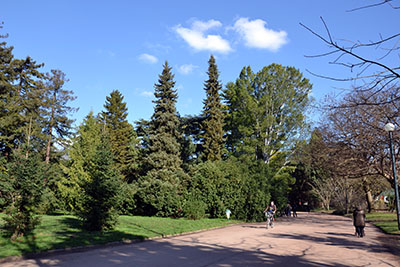
out over 117 ha, the Park de la Tete d'Or is the largest park in France
that can be found in the heart of a city. According to a legend, a
golden head of Christ is buried in the park, thus giving way to the
name "Tete d'Or". Responsibility for the creation of the
park was put into the hands of Denis Bühler, a landscape architect.
Since its opening in 1856, the park has remained largely unchanged,
with its lakeshore, large paths lined with hundred year old trees,
zoological park, and botanical gardens (created respectively in 1865
and 1887) all reflecting the original layout. The only recent addition
was the Rose Garden in 1961. |
 |
 |
With its beautiful
natural setting, the Park de la Tete d'Or will enchant the entire
family.
Whether to go for a jog, take a walk, try your hand at fishing,
enjoy a refreshment, or discover one of our many spare
time activities, you'll always find a reason to come and enjoy
this wonderful park by yourself or with friends and family.
Free
entrance
Open from 6:00am to 11:00pm from the 1st of April
to the 30th of September
(to 9:00pm during the rest of the year)
For further information, please contact: 04 78 89 02 03 |
|
|
| |
|
| The
zoological park |
|
| The
zoological park of the Parc de la Tête d'Or is the second
one to have been created in France.
The zoo includes
1,000 animals, which are divided into 2 groups: 300 animals bred
in captivity and 700 animals from the wild (250 mammals, 300 birds,
80 reptiles and 70 fish) . In particular, these animals include
Atlas lions, Bengal tigers, Chinese leopards, European brown bears,
giraffes, Indian elephants, anacondas, and the Nile crocodile.
|
|
|
More and more,
we attend to births on site in order to ensure the perpetuation
of certain species.
Certain large cats that are threatened by extinction are currently
being bred in the zoo.
Additionally, one can also meet Indian buffalo, wolves, Senegalese
dwarf goats, baboons, chimpanzees, green monkeys, and more!
All together,
14 animal trainers look after this menagerie!
|
|
|
The
zoological park has 3 major roles:
- educational: by facilitating the discovery of nature
- recreational: by allowing visitors to walk among the animals
- scientific: through a partnership between the park and the University/National
Veterinary School of Lyon |
Free
entrance
Open from 9 am until 5 pm (winter), 9 am until 6:30 pm (summer)
For further information, please contact: 04 72 82 35 00 |
| The
botanical garden accounts for 15000 plants, 3500 from temperate
regions, 760 species of shrubs, 100 species of wild roses, 570 historical
roses, 200 varieties of peonies, 1800 species of mountain plants,
around 50 varieties of nympheas, and 6000 species inside the greenhouses.
It also holds one of the richest collections in Europe and as such,
is highly valued by worldwide scientists who come to visit. |
 |
|

Free
entrance
Open from 9:00am to 11:30am and from 1:30pm to 4:45pm.
For further information, please contact: 04 72 82 35 00
|
The
various greenhouses are:
- the giant greenhouses, with a central 21-metre high pavillion
for luxuriant tropical plants, such as the over one hundred year
old camellias.
- The aquatic greenhouse, containing the famous Amazonian nenuphar,
with leaves that reach a diameter of 1.5m.
- The Dutch greenhouse, inhabited for 40 years by carnivorous
plants.
- The small warm greenhouse, with orchids etc.
- The small cold greenhouse, containing plants with horticultural
flowers such as azaleas, cacti, etc.
The greenhouses,
the largest set in France, constitute 5200 m2 of the total area
of the park and allow the preservation of 6000 species.
|
| The
rose Garden |
 |
|
|
The Park de
la Tete d'Or contains 4 Rose gardens:
- - the competition
rose garden, where every year, a jury chooses from among different
rose creations and awards the prizes of the Most Beautiful Rose
of France and the Great Rose of the Century.
- - The new
Rose garden, inaugurated in 1964, with 60 000 rose bushes representing
the 302 most commonly found varieties of roses in France and
abroad.
- - The historical
rose garden, a part of the botanical garden, with its 570 varieties
of roses.
- - The hundred
species of wild rose bushes in the botanical garden constitute
the 4th part of this remarkably well-balanced set.
|
 |
|